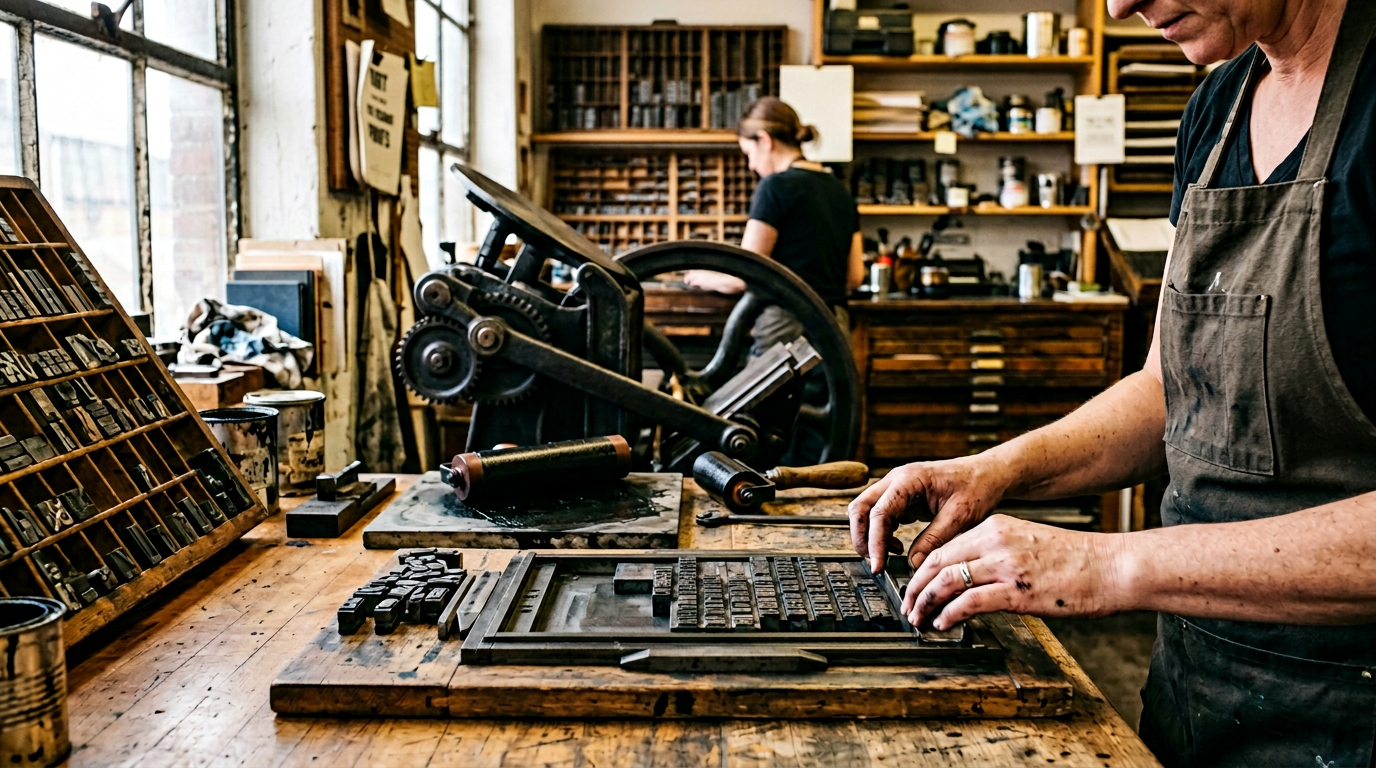
Letterpress printing was once industrial infrastructure. Today, it appears in workshops and community studios where people want a slower, tactile alternative to screen-based design.
Beginners quickly learn practical terms like leading, registration, and ink coverage. These concepts sound technical, but they become intuitive once participants handle type and press setups directly.
The appeal is physical feedback. You can feel pressure, alignment, and paper texture in real time, which gives newcomers a clearer sense of how design decisions affect outcomes.
Workshops often attract mixed groups: graphic designers, students, hobbyists, and retirees with printing memories from earlier decades. That variety helps classes feel collaborative rather than intimidating.
Instructors emphasize process over perfection. Small imperfections are treated as part of the craft, not failure, which encourages experimentation and reduces fear of making mistakes.
Many studios pair letterpress with modern workflows. Participants sketch digitally, then translate designs into physical prints, combining contemporary tools with traditional production methods.
The practical uses are broader than greeting cards. Local organizations print posters, event materials, and short-run editions that stand out in neighborhoods saturated with generic templates.
Cost remains a challenge because presses, maintenance, and paper quality require investment. Shared equipment models help keep classes affordable and preserve access for beginners.
From an educational perspective, letterpress teaches transferable skills: patience, sequencing, attention to detail, and an understanding of typography as a material practice.
The final output might be a wedding invitation or a simple postcard. Yet the deeper value is continuity, a reminder that making by hand still has cultural and practical relevance.
As more community spaces adopt these workshops, letterpress is becoming less of a niche nostalgia activity and more of a useful creative pathway for people of all ages.